Tuesday, 13 December 2016

Scottish Ballet: Hansel & Gretel

Scottish Ballet: Hansel & Gretel

★★★★
Review by Stephanie Green | 13 Dec 2016
Published by The Skinny magazine.

Magic, humour, a frisson of scariness, a celebration of food and a happy ending: Hansel & Gretel, choreographed by Christopher Hampson, is perfect for a Christmas family outing

This revival of Hampson’s 2013 production, using music from Engelbert Humperdinck’s opera plus other pieces, grew from outreach sessions exploring what really matters to children: loving parents, and food. There’s no wicked step-mother, the witch is not too terrifying, and, charmingly, local children appear on stage.
On stage, a fridge – empty except for beer – and a TV dominate, alongside an ironic ‘Home Sweet Home’ sign. The boozy father (Evan Loudon)’s staggering dance with his cronies, and clowning about with cigarette-smoking mother (Marge Hendrick), are humourously done. Later on, in the children’s dream, she is an Audrey Hepburn and he's in black-tie; still smoking and drinking, albeit more classily. The dance of the rebellious Hansel (Andrew Peasgood) and his bossy elder sister, Gretel (Bethany Kingsley-Garner) is convincingly childlike, hungry but playful. Unlike in the Grimm original, their sortie is an adventure.

And here the scary magic begins: Araminta Wraith's Witch, whom we first see as a teacher, is glimpsed as a glamour puss surrounded by rockers. Transformed into a moon fairy, her cloak streaming, she is held aloft by her now-feathery henchmen, hints that her beauty is drawn from her evil suggested by jagged hand-shapes.
Act One in the forest drags a little, despite an atmospheric set. It’s saved by the ravens, their leaps a highlight, as well as a banquet dream sequence with plenty of colourfully-costumed waiters, waitresses, chefs, and cute strawberry tarts. The Sandman (Christopher Harrison), reminiscent of Johnny Depp, is fatally alluring and in Act Two, Dewdrop tutu-clad ballerinas perform a classical routine to please balletomanes.
The pièce de resistance comes, of course, when the fairy takes off her wig, revealing a scabby hunchback witch, her hobbling both scary and humourous. A shame then that there’s a dramatic faux pas: the shocking beheading of the teddy followed by an anodyne scene of floppy toys which cancels out the impact. But hooray, it’s the teddy-hugging Hansel who pushes the witch into the oven.

Hansel & Gretel by Scottish Ballet 
Festival Theatre, Edinburgh, Sat 10 - Sat 31 Dec, various times, £14.50-£43.50 (plus concs); £11 stand-by tickets for Under 26s. For details of audio-described performances, Wee Hansel & Gretel, pre-show talks, and family insights, click here. Also touring to Glasgow, Aberdeen, Inverness in January 2017.
https://www.scottishballet.co.uk/event/hansel-gretel

Monday, 5 December 2016

Alice's Adventures in Wonderland


Alice’s Adventures in Wonderland

Alice’s Adventures in Wonderland

Review

★★★★★
Stephanie Green | 05 Dec 2016
Published in The Skinny.
0

A treat. What better way to celebrate the festive season than this rambunctious, zany version of Alice’s Adventures in Wonderland written and directed by Anthony Neilson plus songs by Nick Powell, puppets and spell-binding special effects. With all the topsy-turvy logic, the vivid colours of a dream, it gets curiouser and curiouser.
Birdsong, fairground lights and music introduce a golden Edwardian summer and picnickers as a boat comes gliding by and we’re in Alice’s world. There’s all the well-known riddles, word play, puns, philosophical and logical conundrums adults remember but made hugely enjoyable for children too: plenty of slapstick, spiralling into sheer silliness – just what the seven year olds in the audience adore. Particularly hilarious are the distinctive walks of animal characters, notably the White Rabbit’s shimmy.
Staying close to Carroll’s original, there are some inspired changes: The Rev Dodgson (Carroll’s real name), not Alice’s sister, sends her to sleep and the trial, not about stolen tarts, but a Mock Turtle soup recipe. A large sun, also a screen, shows great animations: Alice’s descent down the rabbit hole, and the Cheshire Cat’s floating grin. Alice’s changing size is wonderfully done (but no spoilers here).
The costumes are stunning, in particular the Gryphon’s layered feathers and the striped, furry caterpillar. Enormous hats are a feature, the Duchess’s very like Tenniel – but also tricorne hats with googly, shiny eyes attached for the frog and fish footmen. 
The most well-loved characters are here: the engaging Mad Hatter (Tam Dean Burn) beside himself with his unanswerable riddle, and the March Hare’s toothiness, the Duchess (Alan Francis) a Pantomime Dame, and Duchess’s Cook performed with wicked glee by Gabriel Quigley. Watch out for the flying plates. The caterpillar (Zoë Hunter) whose infuriatingly changeable opinions are delivered with superb timing. The Gryphon, or Gryff, a Welshman of course, played by David Carlyle, shouts out Tourette’s style. Isobel McArthur’s sobbing Mock Turtle is glorious and Alice, the debut stage performance for Jess Peet, is self-assured, well able to stand up to the nonsense around her. Great ensemble acting gets hysterical, higher and higher as the performance goes on. A terrific show.
Alice's Adventures in Wonderland, Edinburgh Lyceum, until 31 Dec

Published in the Skinny Magazine online.


Saturday, 26 November 2016

Rambert - Ghost Dances

Rambert – Ghost Dances, Frames and Tomorrow

Feature by Stephanie Green | 26 Nov 2016

Published in The Skinny Magazine


The iconic Ghost Dances, [★★★★★] visceral, sinister and melancholic, with its meld of skeletal Ghosts and folk dancing Dead, still in its 36th year, holds its power. Inspired by the military takeover of Chile, this is a non-polemical, imagistic piece, sadly still with universal relevance. In Rambert’s 90th year, what better than to revive one of their most popular pieces, choreographed by their former Artistic Director, Christopher Bruce?  
The sound of the wind, and the arid Andean backdrop give this an elemental atmosphere. The three skeletal Ghosts wear terrifying skull-masks influenced by the Mexican holiday, The Day of the Dead. Their movements are reptilian, lithe with sudden stops, eyes probing the audience in a chilling way. We are implicated in the universal fact of death. The Ghosts jump in off-balance barrel turns, or pose with arms swinging to suggest their provisional nature in contrast to the zombie-like approach of the Dead, dressed in colourful, tatty clothes. 
A live band performs the melancholic Latin American music with its distinctive breathy flute, inspired by the Chilean folk group Inti-Illimani.  A curiously defiant gaiety is mirrored in the folkloric dance steps as the Dead relive the past in striking duets: a girl in red, and a man with tie pulled playfully by his partner. The Ghosts weave amongst them then suddenly claim them – a particularly striking image is women raised aloft as if hanged. Death is brutal, unexpected. A brilliant, must-see production.
 Frames [★★★☆☆] choreographed by Alexander Whitley is interesting, but one waited with bated breath for the steel rods to come tumbling down. There is a startling image when the ensemble creates unfolding shapes with the rods like wings but overall, despite impressive dancers, there was no sense of relationship between dance moves and rods.  
As for Tomorrow [★★☆☆☆], this piece does Lucy Guerin’s career no favours. A split stage shows dancers in white rags twitching with spasmodic gestures symbolizing the psychic turmoil in ‘Macbeth’, the charismatic Miguel Altunaga drawing one’s eye. But on the other side, dancers in black suits mime like actors in an embarrassing am-dram production. The plot is run backwards. Why? Not a clever piece of deconstructivist post-modernism, just banal. 

http://edtheatres.com/rambert

Tuesday, 23 August 2016

MC 14/22 (Ceci est mon corps) and Crystal Pite's Emergence

Scottish Ballet: MC 14/22 / Emergence


Review by Stephanie Green

A well-matched double-bill, both about crowd mentality, but contrasting in mood, one dark, one bright: the first exploring masculinity, the other the ‘swarm intelligence’ of bees.

Angelin Preljoçaj’s work is known for its darkness and MC 14/22 (Ceci est mon corps) (‘This is my body’) [★★★] is no exception. The title is a reference to the Last Supper but this piece concentrates more on the male body: an ambivalent paean to masculinity. Glistening torsos are well-lit, the rest of their bodies disappearing in shadow, the males grapple, or slap each other’s bodies on steel tables reminiscent of the morgue. No heroes, they turn on each other, just like the Apostles. There is little individuality as they move in delayed synchronicity, bordering on monotony. If this is dance pushing the boundaries, of the dancers’ exhaustion and the audience’s tolerance, this is a close run thing.
There are only brief references to the Bible: a tender moment of foot becomes body washing and striking tableaux reminiscent of Da Vinci’s Last Supper. Christ’s humiliation is suggested: a man sings a haunting hymn whilst tormented, another attempting to dance whilst his limbs are taped, but these incidents verge on silliness. A splendid scene where dancers dive from a height to be caught would have been a splendid ending, but unfortunately the piece has no climax – it just stops.
Emergence [★★★★★] choreographed by Crystal Pite is a triumph. Abstract dance is balanced with insectoid hints: elbows raised like wings, jerks of the head. The ‘swam intelligence’ of bees is brilliantly matched to the regimentation of a ballet company. Set and lighting were dramatic: black streaks suggesting a ‘nest’ and the lit tunnel from which the dancers can emerge or dance inside in shadow-play. The highlights are a brilliant sequence when the ballerinas advance en pointe to be pushed back by the males and the entire company massed at the end, counting (humming?).

Published in The Skinny Magazine online.

Tuesday, 16 August 2016

Natalia Osipova & Guests


Natalia Osipova

  Photo by Bill Cooper

Natalia Osipova & Guests @ Festival Theatre

Review

★★★★
Stephanie Green | 16 Aug 2016
6
1

An exciting triple bill of dramatic contrasts shows off ballet star Natalia Osipova to stunning effect as her classical training skills meld with contemporary dance

Run Mary Run, choreographed by Arthur Pita is deliciously melodramatic. A tale of doomed teenage love, set in the 60s to the broken-hearted pop ballads of The Shangri-las, there’s a hint of Amy Winehouse’s tragic fate here.
Hands rise from black gravel, as the lovers rise from their grave to relive the fatal attraction between Osipova's sweet, naïve lead, wearing an auburn beehive and teeth-gritting acid greens and oranges, and her no-good man, performed by Sergei Polunin as a James Dean/Belmondo/Marlon Brando type, with louche walk, leather jacket and jeans. This is a series of vivid vignettes, more drama than dance: Polunin's solo sees him kicking the gravel into a swirl of dust. There's a moment of sugary sentimentality as Ospiova is spun on a swing by Polunin, whose clever juggling trick with glass and fag offers relief before the inevitable tragedy to come.
Choreographed by Moroccan/Belgian Sidi Larbi Cherkaoui, Qutb (which means ‘axis’ or ‘pivot’ in Arabic) is breath-taking. An awe-inspiring vast orange-red sun, occasionally eclipsed, dominates the back screen, and later appears on the ground. Three dancers rotate around it, aligning with each other and coming together or separating in an abstract dance which suggests planets orbiting the sun, reminiscent of whirling dervishes – all to the strains of nerve-tingling Sufi chanting. Osipova’s two male dancers, James O’Hara and Jason Kittelberger, get down and dirty, bringing an embodied physicality to proceedings.
Silent Echo is the most purely classical piece on the bill, a pas de deux choreographed by Russell Maliphant celebrating Osipova and Polunin’s strengths: superb lines, lifts and (a treat) the latter’s famed leap. The abstract classicism takes on a weird character set against Scanner’s electronic rock and some strobe lighting. Indeed at times, it is almost a duet with light, designed by Michael Hulls.

Natalia Osipova & Guests, Festival Theatre, 12-14 Aug, 7.30pm, £12-32 (fees apply)

Published in the Skinny Magazine online.

Friday, 28 August 2015

Seven: Ballet am Rhein

Seven: Ballet am Rhein @ Edinburgh Playhouse, 20 Aug

Germany's Ballett am Rhein team up with the Royal Scottish National Orchestra to perform Martin Schläpfer’s response to Mahler’s Seventh Symphony

★★★
Review by Stephanie Green | 28 Aug 2015
Published in The Skinny Magazine.

Pointe ballet shoes, bare feet and boots sum up this contemporary ballet inspired by Mahler’s Seventh Symphony, superbly played by the Royal Scottish National Orchestra and conducted by Wen-Pin Chien. Interrupted fragments of folk music, martial, or lyrical passages are echoed by the choreography: a collage of disconnected vignettes, Balanchine-inspired neoclassicism or tanztheater, in a  nocturnal dream world we cannot quite grasp.
Love duets become casually dismissive. Ugly contortions and drumming boots express abusive relationships: a male drags a female on stage with her head under his arm; others are dragged by the hair or lifted into the air with legs akimbo revealing too much crotch, albeit clothed in functional gym knickers. The males suffer too but there is something unpleasantly misogynistic in this piece, though occasionally the females fight back, usually en pointe and with hair in a bun.
Just as Mahler inserts cow horns, Schläpfer’s depressing view of humanity is undercut with silliness – dancers imitating a train or the girl underneath a tiny table (why?) but despite these moments, and extraordinary athletic dancers performing difficult choreography, its fragmentary nature is unsatisfactory and does not do justice to Mahler’s subtlety.
Only in the more cheerful Rondo is there a strong change of mood, when neoclassical dance is underpinned by the whole company in boots and long coats rushing round chairs in a circle, reminiscent of a children’s game where someone will be ‘out’. A reminder of the Holocaust, or of any outsiders in society. Finally, rather late, this stunning scene gives the whole piece depth.

Seven: Ballett am Rhein, Edinburgh Playhouse, run ended
http://eif.co.uk/seven

Thursday, 20 August 2015

The Encounter - Simon McBurney of Complicite

The Encounter @ EICC, 16 Aug

An astounding, immersive show, The Encounter is performed and directed by Simon McBurney of Complicite

★★★★
Review by Stephanie Green | 20 Aug 2015
Published in The Skinny.

The audience is equipped with head phones, where sound is relayed from a totem-like binaural ‘head’, so that we too are dropped into the Amazonian rainforest of Brazil. Based on Petru Popescu’s Amazon Beaming about Loren McIntyre, a National Geographic photographer captured by the Mayoruna (Cat people) and the recordings of McBurney’s own trip, we too experience a destabilizing encounter.
What is real? What is the nature of time? McBurney plays with our perception of reality with real-time performance and recordings jumping back and forth in time. He is the only person on stage but he performs many characters who inhabit our imagination while a mosquito whines at our ear, or a jaguar coughs. Sound effects are created on stage – pouring a plastic bottle to create the river, or screwed-up video tape for walking through jungle undergrowth. The voices of McIntyre and the Amazonians are intercut with McBurney’s own young son back home asking unanswerable questions, as children do, and those of scientists, philosophers and activists on how for the índios, contact with ‘whites’ often means death.
We share McIntyre's experiences; how he loses his trainers, his watch, his camera... everything that makes a 20th century person; how he enters a new sense of consciousness and learns to speak the ‘old language’, communicating through silence with the head-man; how he undergoes terrifying drug-induced hallucinations to reach another reality, the pulsing rhythm of time, and we too emerge shaken.

The Encounter, EICC, 'til 23 Aug, 7:30pm (2:30pm), £32
http://www.eif.co.uk

Thursday, 13 August 2015

Antigone

Antigone @ King's Theatre

★★
Review by Stephanie Green | 13 Aug 2015
Published in The Skinny.

Can a famous film star automatically perform successfully on the stage? In the case of Juliette Binoche in Sophocles’ Antigone, sadly not. Despite the renowned Ivo van Hove's direction, and being an iconic play of enormous power, this modern dress production is hugely disappointing.
Antigone must bury her brother Polyneikes while Kreon, the king, has decreed that as a traitor, he must be left to the birds and dogs: obedience to the state or to humane values, a moral conflict that resonates to this day. It needs exceptional actors. Binoche lacks gravitas. Her voice is thin. She gabbles or is inaudible. Later she shouts, mistakenly thinking that conveys emotion. The only time she expresses pathos is when she silently washes her brother’s corpse.
The low-key tone counterbalances the gruesome plot, and allows some pleasing comedy from Obi Abili, but too often makes for impassive acting. The text translated by US poet Anne Carson is banal (‘Why are you so nasty?’). Thank goodness for Patrick O’Kane who is a credible, cynical Kreon, though often inaudible. Only Finbar Lynch as Teiresias is superb and other parts are strong: Kathryn Pogson as Eurydike and Kirsty Bushell as Ismene.
The simplicity of Jan Versweyveld’s bare set dominated by a vast sun is perfect for such a stark play but the light is so glaring it casts the actors’ faces into shade. Projections on the back wall of deserts are effective but others are distracting or kitsch. And why the soundtrack? It’s irritating, and the track at the end ludicrous.

Antigone, Kings Theatre, 'til 22 Aug 7.30pm (except Mondays)
Sat 15 and 22 Aug 2.30pm Prices vary.
Antigone, Kings Theatre, 'til 22 Aug 7.30pm (except Mondays) Sat 15 and 22nd Aug 2.30pm Prices vary. http://eif.co.uk/antigone

Tuesday, 11 August 2015

Sylvie Guillem: Life in Progress

Sylvie Guillem: Life in Progress @ Festival Theatre

★★★★★
Review by Stephanie Green | 11 Aug 2015
Published in The Skinny magazine.
6
  
0
 
0
  

  • Sylvie Guillem
Sylvie Guillem: Life in Progress, EIF


Subtle, intelligent, playful and moving, Life in Progress exemplifies Sylvie Guillem’s attitude through the 39 years of her dance career: balancing fun and risk, continuing to search for new possibilities, melding early classical training and moving to contemporary dance. The choreographers and co-dancers chosen here have all been important in her life and exemplify this approach. In fact, each piece feels as if we are experiencing the process of it being made.
Kathak-trained Akram Khan’s technêis introspective and compelling, involving many ground-based restless contortions superbly responsive to the Indian rhythms of the percussion.
Duo2015 is choreographed by William Forsythe, who strongly influenced Guillem’s development. Performed by Brigel Gjoka and Riley Watts, it is a tongue-in-cheek piece about male competitiveness which becomes increasingly technically demanding.
Russell Maliphant’s Here & After is a sinuous and elegiac duet with Emanuela Montanari (whom Guillem has produced in the past) set to Andy Cowton’s haunting music and impressive lighting by Michael Hulls, which encloses the dancers, patterning the stage with squares from which they dance in and out.
The delightful Bye, choreographed by Mats Ek to Beethoven’s Piano Sonata in C minor, Op 111, features Guillem in plaits and a cardie – herself as a little girl, perhaps a Pippi Longstocking – dancing awkwardly then flinging off her shoes, free to find herself. An intriguing light effect, a lit door she slips in through and later leaves to join others, is a wonderful symbol of her continual search for new life.

Sylvie Guillem: A Life in Progress, Festival Theatre, run ended
Sylvie Guillem - A Life in Progress, Festival Theatre, run endedhttp://www.eif.co.uk/guillem

Monday, 10 August 2015

The Best of Dance Base, Edinburgh Festival Fringe, 2015


The Best of Dance Base

Stephanie Green and Mark Harding | 10 Aug 2015   Published in The Skinny Magazine online.

Dance Base is the place to be if you want to know what’s going on in the contemporary dance world. As ever, artistic director Morag Deyes’ extraordinarily varied programme continues to enthral, surprise and at times, shake you to the core.
The exquisite Ink of Innocence [★★★★☆] is a highlight of Dance Base’s offerings, shown as part of the Special Edition double bill. Choreographed by Eve Mutso, the interaction between a dancer in white with others in black is fluid, imaginative and tightly controlled. More impressively, this piece is expressive in a way not often achieved by classically trained companies. But why the ropes? Their potential is unexplored. 1 to 10  [★★★★☆], literally playing on numbers, choreographed by Jamiel Laurence was witty and sharp, a perfect foil. SG
Exciting new companies E Motion and Tamsyn Russell burst onto the scene with explosive energy earlier in the year.  E Motion, as the company name suggests, presents Between Us [★★★★☆], a piece full of emotion and choreographed by Emma Snellgrove. Charting female relationships and break-ups, it is intense but with a surprising, delightful sense of humour, if at times rambling.  Atzi Muramatsu’s live cello accompaniment is a superb call and response to the choreography. The athletic Hunting Dust [★★★☆☆] is equally full of joy and humour, exploring gender issues and competitiveness but did not seem to know how to end. SG
Sleazy come-on glances of dancers greet the audience. Gaze of the Kavaluan [★★★★☆] by the Taiwanese Tjimur Dance Theatre should be x-rated. Superbly danced, it is a raw protest against the restrictive mores of traditional society. Sex, not love, is seen as the antidote. The brooding symbol of virginity entrapped in voluminous black veil is disturbing, especially when she almost chokes on her scream. The dancers are feral, especially when smelling each other’s sexuality – a particularly affective moment is when the Virgin’s lilies hang from their lips. SG
Nijinsky’s Last Jump [★★★★☆] by Company Chordelia is devastating, a play/dance exploring Nijinsky’s schizophrenia and the years of cruel treatment he endured in asylums. Both dancer Darren Brownlie and actor James Bryce playing Njinsky’s younger and older selves are moving. There are some wonderful lines (‘You just go up and pause a little up there’) but The Skinny was a bit disappointed that dance does not feature more prominently – however, there is a wonderful depiction and development of poses from the photographs of Nijinsky as a faun and evocative use of excerpts of the music he danced to, from Debussy to Stravinsky. SG
Al Seed in Oog [★★★★☆] is a commanding solo presence. Backed by terrific lighting and soundtrack, he plays a soldier who has crossed the edge of mental breakdown. Transforming from damaged human, eyes grow from pinpricks to saucers, mouth twists from joker to black tunnel, a war machine with no trace of humanity left – or is there? Exemplary physical theatre, and Alex Rigg’s overcoat is a character in its own right.  MH
Fishamble’s Underneath [★★★★★] is billed as a one-man ‘play’ but this does not evoke the sheer brilliance of this tour de force: Pat Kinevane is both ghoul and charming Irish raconteur in the pub, telling a sad tale of a young girl’s endurance of bullying for her ‘disability’ (scarred by lightning) with amazing changes of mood, from emotionally shocking scenes to flashes of humour, an array of characters (including a house-hunting couple and Galapagos, the slowest man ever), and themes ranging from Lourdes to Downton Abbey. No dance, some physical theatre: it is sure to be the talk of the festival. MH
And why not savour a meditative moment with Green Tea and Zen Baka first thing?

Nijinsky's Last Jump, Dance Base, 'til 23 Aug, 2pm, £10/£8
Between Us + Hunting Dust, Dance Base, 'til 16 Aug, 3:30, £10/£8
Special Edition 2015, Dance Base, 'til 23 Aug, 5pm, £10/8
Taiwan Season: Gaze of the Kavaluan, Dance Base, 'til 30 Aug, 6:30pm, £10/£8
Underneath, Dance Base, 'til 30 Aug, 7:30pm, £10/£8
Oog, Dance Base, 'til 23 Aug, 9:30pm, £10/£8

Wednesday, 3 September 2014

Sweet Mambo - Pina Bausche company

Sweet Mambo @ Edinburgh International Festival

★★★★
Review by Stephanie Green | 03 Sep 2014       
Published in The Skinny magazine.   
0
Sweet Mambo @ Edinburgh International Festival

"Don’t forget," say each of the female dancers introducing themselves in turn.
Sweet Mambo, first performed in 2008, is Pina Bausch's penultimate piece, without the dark desolation  or visceral force of her earlier works but still wonderfully life-affirming,  with the imaginative power for which she is famed,  transforming dance choreography into an immersive experience. 
Beautiful, poetic, and humorous, if tempered with ambiguity, there is something mercurial about Sweet Mambo. It is sweet in the best sense, not sugary sweet, but charming, erotic and delicate, laced with humour and an uncomfortable  feeling that not all is well and indeed moments of violence and anguish.  It is about the bitter-sweet game of love, so all-consuming but how easy it is to mistreat or forget past lovers.
There is no narrative.  Sweet Mambo proceeds by a series of emotional vignettes where the eroticism of the first act is largely from a female perspective. The women are in beautiful slinky satin long gowns, designed by Marion Cito. The male dancers, dressed in black,  are mainly merely props but it is also a refreshing reversal of so much male-oriented sexualised objectification of women as the men kiss, no, caress the women’s backs with their lips.  All very delightful until the one-sidedness of this experience becomes worrying especially when the men poke their heads through the women’s arms and are forcibly dragged round. The fawning, abject position of the men turns love into a power game.  The men become increasingly violent in their turn; one pulls a woman by her long hair; another ignores a woman who shouts ‘Talk to me’.  ‘Alright, then,’  she turns away finally: ‘I’ll just talk to myself,’ eliciting laughter from the audience.
This is typical of Bausch’s method  which can change mood from one sequence to another: a deeply emotional piece in a forest-scape is interrupted by a dancer declaring she loves to cartwheel and then proceeding to cartwheel round the stage.  These jump-cuts and other techniques borrowed from film, such as replaying a sequence in a loop, are particularly  effective for creating hysteria. One example is when Julia Shanahan runs across the stage pursued by two male dancers who grab her by the arms and force her to run back to the start, again and again until her growing  anguish becomes unbearable.
The music too is not one piece but extracts from different artists, all creating the mood of mambo, a Cuban dance music. Various soundtracks from Barry Adamson, Portishead, Tom Waits, to Nina Simone and many others, create a super-cool rhythmic background. The set, Peter Pabst’s set of  white curtains are an inspired dreamscape – all the more remarkable to learn that the curtains were left over from the company’s previous Indian tour and re-used for financial reasons – now re-imagined, billowing around the dancers, played with, the dancers appearing in and out of the folds. In an extraordinary scene a dancer crawls and swirls inside a great bubble-like cloud which blows in from the wings  to the sound of Lisa Ekdahl singing Cry Me a River – the highlight of the piece.
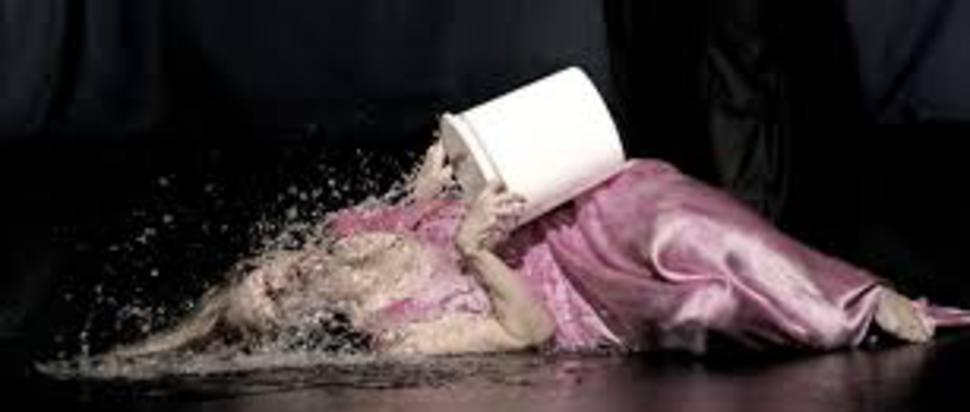
Later the atmospheric filmic projection of a forest, branches waving in the wind, spreads onto the floor of the stage.  A silent clip of couples at a party from the black and white 1938 film Der Blaufuchs (The Blue Fox) by Viktor Tourjansky and starring Zara Leander plays on the backdrop as a dancer gyrates to climax  on a man’s lap. Later the dancers move round the stage as if they too are at a cocktail party and even raise their glasses to the audience.  The boundaries of art and reality are further crossed as dancers address the audience directly. ‘Tell me your problem’ a dancer bends down to address the front row, ‘and I will scream for you.’ Julia Shanahan sloshes herself in real water from buckets – though it was a disappointment that more was not made of this. 
The overall experience conveys such a celebratory joyousness, this is the must-see performance of the festival.
Run ended

Thursday, 19 September 2013

Madame Freedom - Hyo Jim Kin and Hyung Su Kin

Madame Freedom @ King's Theatre

★★★★
Review by Stephanie Green | 19 Sep 2013
Published in The Skinny Magazine.


Tradition and modernity meet head-on in this stunningly beautiful interactive performance of dance, film and innovative computer-generated visuals by a husband and wife team: choreographer and dancer Hyo Jim Kin with artist Hyung Su Kin. The dance re-creates and is performed in front of extracts from the 1950's film Madame Freedom, about a woman who seeks self-expression through work and sexual experiences outside the constraints of marriage, a film which caused a shocking sensation at the time and even today is relevant, not only to Korea but to the west, posing the question: how free is free?
The performance starts with a film of a woman being dressed by servants in Hanbok traditional costume. Below this image, the dancer, dressed all in black - long-sleeved jacket, baggy trousers and black tight slippers -performs Tae Phyung Moo, Peace Dance, a traditional Korean dance similar to Tai Chi based on control of breath and stop/start moves, which then develops into contemporary modern dance, a spell-binding sequence as we see her breaking out of the straitjacket of the past.
Later we see her in a western-style slinky dress and high heels with her dance-teacher and lover, performing latino dances to music and song performed above in the film, referencing a craze for anything American which followed Korea's liberation from Japan. The focus shifts between dancer and film image - sometimes the two combine, when the dancer is superimposed in the film and appears to have climbed inside. Inevitably, pairing the dancers with the film means that the huge, bright image of the singer shimmying in a tasselled dress draws the audience's eye, and the silhouetted figures of the dancers in shadow below are dwarfed, but it appears this might be intentional. However, you can begin to see that the interplay of shadow and light is central to the play of duality, the central theme. In fact, the significance of the woman's first dance, the Tae Phung Moo, becomes clear.
Represented by the Tao symbol, the Korean Taegeuk, which celebrates the balance of opposites - light and shadow, tradition and modernity - this aesthetic infuses the whole performance. Everything is set up as a binary and built in pairs: the central screen is split, so that the image is warped each time; there are two screens, one either side of the stage, playing simultaneously. In one scene a film of the dancer leans in to an open gate-way, and we see her face. On the other side we see her in the identical position, but her back-view. This gateway, to Korean eyes, is significant since it is the gateway to the palace Kyong Bok's servants' quarters. In the same way, Madame Freedom wants to break out of the confinement of the life of a servant to her husband as house-wife.
Later when the dancer merges with the extraordinarily inventive black and white video designs swamping the screens and stage, the interplay of shadow and light, dancer and visuals is most successful, wonderfully expressive of her guilt and despair once her affair is over. This is intensely moving, especially when the white behind the black designs grow larger and brighter, forcing the black shapes to fall as the dancer flings herself to the floor, then rears in agony. While so much of the technology in this year's Edinburgh International Festival's theme of the interface between the arts and technology has hardly illuminated the art work it is paired with, Madame Freedom has been a striking exception.
Run nded
http://www.eif.co.uk/madamefreedom

Thursday, 23 August 2012

50 Acts - Wendy Houstoun

50 Acts – Wendy Houstoun @ Dance Base

A lively performanace combating ageism

★★★
Review by Stephanie Green | 23 Aug 2012
Published in The Skinny Magazine.


Stunning videos and humourous use of text, mime, speech and movement, make this an inventive piece of experimental physical theatre, full of authenticity about being age 50+.
Former collaborator with Lloyd Newson's DV8, Wendy Houstoun  surprises us with various random acts.  Very active and flexible, she rushes around, frequently with intentional falls, acknowledging the fear of frailty.  But she combats ageism with ironic humour, wearing a hard hat, complaining at youth telling 'old' people, at least over age 33, to stand aside, and a great scene when anger takes over and she smashes vinyl records with a hammer to a music-score. The humour turns bitter and the juxtaposition of a speech about cuts by David Cameron is particularly effective  played against a film of chorus girls while Houston sits in a chair as if in a care-home.
Throughout the piece, Houston draws attention to artifice and theatricality by referencing what she is doing: "Now I will stand here," as she stands, or later "Now I will gesture" as she gestures. It is clever, but rather distancing. Perhaps it was why, though charmed and touched at times, I was not deeply moved. But does that matter? Originality and humour go a long way.
Three performances only Fri 17-Sun 19 Aug at 9.30pm Age guidance 14+ All tickets £12 (£10) Running time 1 hour Dance Base, 14-16, Grassmarket, EH1 2JU 0131 225 5525 www.dancebase.co.uk