Thursday, 20 August 2015

The Encounter - Simon McBurney of Complicite

The Encounter @ EICC, 16 Aug

An astounding, immersive show, The Encounter is performed and directed by Simon McBurney of Complicite

★★★★
Review by Stephanie Green | 20 Aug 2015
Published in The Skinny.

The audience is equipped with head phones, where sound is relayed from a totem-like binaural ‘head’, so that we too are dropped into the Amazonian rainforest of Brazil. Based on Petru Popescu’s Amazon Beaming about Loren McIntyre, a National Geographic photographer captured by the Mayoruna (Cat people) and the recordings of McBurney’s own trip, we too experience a destabilizing encounter.
What is real? What is the nature of time? McBurney plays with our perception of reality with real-time performance and recordings jumping back and forth in time. He is the only person on stage but he performs many characters who inhabit our imagination while a mosquito whines at our ear, or a jaguar coughs. Sound effects are created on stage – pouring a plastic bottle to create the river, or screwed-up video tape for walking through jungle undergrowth. The voices of McIntyre and the Amazonians are intercut with McBurney’s own young son back home asking unanswerable questions, as children do, and those of scientists, philosophers and activists on how for the índios, contact with ‘whites’ often means death.
We share McIntyre's experiences; how he loses his trainers, his watch, his camera... everything that makes a 20th century person; how he enters a new sense of consciousness and learns to speak the ‘old language’, communicating through silence with the head-man; how he undergoes terrifying drug-induced hallucinations to reach another reality, the pulsing rhythm of time, and we too emerge shaken.

The Encounter, EICC, 'til 23 Aug, 7:30pm (2:30pm), £32
http://www.eif.co.uk

Thursday, 13 August 2015

Antigone

Antigone @ King's Theatre

★★
Review by Stephanie Green | 13 Aug 2015
Published in The Skinny.

Can a famous film star automatically perform successfully on the stage? In the case of Juliette Binoche in Sophocles’ Antigone, sadly not. Despite the renowned Ivo van Hove's direction, and being an iconic play of enormous power, this modern dress production is hugely disappointing.
Antigone must bury her brother Polyneikes while Kreon, the king, has decreed that as a traitor, he must be left to the birds and dogs: obedience to the state or to humane values, a moral conflict that resonates to this day. It needs exceptional actors. Binoche lacks gravitas. Her voice is thin. She gabbles or is inaudible. Later she shouts, mistakenly thinking that conveys emotion. The only time she expresses pathos is when she silently washes her brother’s corpse.
The low-key tone counterbalances the gruesome plot, and allows some pleasing comedy from Obi Abili, but too often makes for impassive acting. The text translated by US poet Anne Carson is banal (‘Why are you so nasty?’). Thank goodness for Patrick O’Kane who is a credible, cynical Kreon, though often inaudible. Only Finbar Lynch as Teiresias is superb and other parts are strong: Kathryn Pogson as Eurydike and Kirsty Bushell as Ismene.
The simplicity of Jan Versweyveld’s bare set dominated by a vast sun is perfect for such a stark play but the light is so glaring it casts the actors’ faces into shade. Projections on the back wall of deserts are effective but others are distracting or kitsch. And why the soundtrack? It’s irritating, and the track at the end ludicrous.

Antigone, Kings Theatre, 'til 22 Aug 7.30pm (except Mondays)
Sat 15 and 22 Aug 2.30pm Prices vary.
Antigone, Kings Theatre, 'til 22 Aug 7.30pm (except Mondays) Sat 15 and 22nd Aug 2.30pm Prices vary. http://eif.co.uk/antigone

Tuesday, 11 August 2015

Sylvie Guillem: Life in Progress

Sylvie Guillem: Life in Progress @ Festival Theatre

★★★★★
Review by Stephanie Green | 11 Aug 2015
Published in The Skinny magazine.
6
  
0
 
0
  

  • Sylvie Guillem
Sylvie Guillem: Life in Progress, EIF


Subtle, intelligent, playful and moving, Life in Progress exemplifies Sylvie Guillem’s attitude through the 39 years of her dance career: balancing fun and risk, continuing to search for new possibilities, melding early classical training and moving to contemporary dance. The choreographers and co-dancers chosen here have all been important in her life and exemplify this approach. In fact, each piece feels as if we are experiencing the process of it being made.
Kathak-trained Akram Khan’s technêis introspective and compelling, involving many ground-based restless contortions superbly responsive to the Indian rhythms of the percussion.
Duo2015 is choreographed by William Forsythe, who strongly influenced Guillem’s development. Performed by Brigel Gjoka and Riley Watts, it is a tongue-in-cheek piece about male competitiveness which becomes increasingly technically demanding.
Russell Maliphant’s Here & After is a sinuous and elegiac duet with Emanuela Montanari (whom Guillem has produced in the past) set to Andy Cowton’s haunting music and impressive lighting by Michael Hulls, which encloses the dancers, patterning the stage with squares from which they dance in and out.
The delightful Bye, choreographed by Mats Ek to Beethoven’s Piano Sonata in C minor, Op 111, features Guillem in plaits and a cardie – herself as a little girl, perhaps a Pippi Longstocking – dancing awkwardly then flinging off her shoes, free to find herself. An intriguing light effect, a lit door she slips in through and later leaves to join others, is a wonderful symbol of her continual search for new life.

Sylvie Guillem: A Life in Progress, Festival Theatre, run ended
Sylvie Guillem - A Life in Progress, Festival Theatre, run endedhttp://www.eif.co.uk/guillem

Monday, 10 August 2015

The Best of Dance Base, Edinburgh Festival Fringe, 2015


The Best of Dance Base

Stephanie Green and Mark Harding | 10 Aug 2015   Published in The Skinny Magazine online.

Dance Base is the place to be if you want to know what’s going on in the contemporary dance world. As ever, artistic director Morag Deyes’ extraordinarily varied programme continues to enthral, surprise and at times, shake you to the core.
The exquisite Ink of Innocence [★★★★☆] is a highlight of Dance Base’s offerings, shown as part of the Special Edition double bill. Choreographed by Eve Mutso, the interaction between a dancer in white with others in black is fluid, imaginative and tightly controlled. More impressively, this piece is expressive in a way not often achieved by classically trained companies. But why the ropes? Their potential is unexplored. 1 to 10  [★★★★☆], literally playing on numbers, choreographed by Jamiel Laurence was witty and sharp, a perfect foil. SG
Exciting new companies E Motion and Tamsyn Russell burst onto the scene with explosive energy earlier in the year.  E Motion, as the company name suggests, presents Between Us [★★★★☆], a piece full of emotion and choreographed by Emma Snellgrove. Charting female relationships and break-ups, it is intense but with a surprising, delightful sense of humour, if at times rambling.  Atzi Muramatsu’s live cello accompaniment is a superb call and response to the choreography. The athletic Hunting Dust [★★★☆☆] is equally full of joy and humour, exploring gender issues and competitiveness but did not seem to know how to end. SG
Sleazy come-on glances of dancers greet the audience. Gaze of the Kavaluan [★★★★☆] by the Taiwanese Tjimur Dance Theatre should be x-rated. Superbly danced, it is a raw protest against the restrictive mores of traditional society. Sex, not love, is seen as the antidote. The brooding symbol of virginity entrapped in voluminous black veil is disturbing, especially when she almost chokes on her scream. The dancers are feral, especially when smelling each other’s sexuality – a particularly affective moment is when the Virgin’s lilies hang from their lips. SG
Nijinsky’s Last Jump [★★★★☆] by Company Chordelia is devastating, a play/dance exploring Nijinsky’s schizophrenia and the years of cruel treatment he endured in asylums. Both dancer Darren Brownlie and actor James Bryce playing Njinsky’s younger and older selves are moving. There are some wonderful lines (‘You just go up and pause a little up there’) but The Skinny was a bit disappointed that dance does not feature more prominently – however, there is a wonderful depiction and development of poses from the photographs of Nijinsky as a faun and evocative use of excerpts of the music he danced to, from Debussy to Stravinsky. SG
Al Seed in Oog [★★★★☆] is a commanding solo presence. Backed by terrific lighting and soundtrack, he plays a soldier who has crossed the edge of mental breakdown. Transforming from damaged human, eyes grow from pinpricks to saucers, mouth twists from joker to black tunnel, a war machine with no trace of humanity left – or is there? Exemplary physical theatre, and Alex Rigg’s overcoat is a character in its own right.  MH
Fishamble’s Underneath [★★★★★] is billed as a one-man ‘play’ but this does not evoke the sheer brilliance of this tour de force: Pat Kinevane is both ghoul and charming Irish raconteur in the pub, telling a sad tale of a young girl’s endurance of bullying for her ‘disability’ (scarred by lightning) with amazing changes of mood, from emotionally shocking scenes to flashes of humour, an array of characters (including a house-hunting couple and Galapagos, the slowest man ever), and themes ranging from Lourdes to Downton Abbey. No dance, some physical theatre: it is sure to be the talk of the festival. MH
And why not savour a meditative moment with Green Tea and Zen Baka first thing?

Nijinsky's Last Jump, Dance Base, 'til 23 Aug, 2pm, £10/£8
Between Us + Hunting Dust, Dance Base, 'til 16 Aug, 3:30, £10/£8
Special Edition 2015, Dance Base, 'til 23 Aug, 5pm, £10/8
Taiwan Season: Gaze of the Kavaluan, Dance Base, 'til 30 Aug, 6:30pm, £10/£8
Underneath, Dance Base, 'til 30 Aug, 7:30pm, £10/£8
Oog, Dance Base, 'til 23 Aug, 9:30pm, £10/£8

Wednesday, 3 September 2014

Sweet Mambo - Pina Bausche company

Sweet Mambo @ Edinburgh International Festival

★★★★
Review by Stephanie Green | 03 Sep 2014       
Published in The Skinny magazine.   
0
Sweet Mambo @ Edinburgh International Festival

"Don’t forget," say each of the female dancers introducing themselves in turn.
Sweet Mambo, first performed in 2008, is Pina Bausch's penultimate piece, without the dark desolation  or visceral force of her earlier works but still wonderfully life-affirming,  with the imaginative power for which she is famed,  transforming dance choreography into an immersive experience. 
Beautiful, poetic, and humorous, if tempered with ambiguity, there is something mercurial about Sweet Mambo. It is sweet in the best sense, not sugary sweet, but charming, erotic and delicate, laced with humour and an uncomfortable  feeling that not all is well and indeed moments of violence and anguish.  It is about the bitter-sweet game of love, so all-consuming but how easy it is to mistreat or forget past lovers.
There is no narrative.  Sweet Mambo proceeds by a series of emotional vignettes where the eroticism of the first act is largely from a female perspective. The women are in beautiful slinky satin long gowns, designed by Marion Cito. The male dancers, dressed in black,  are mainly merely props but it is also a refreshing reversal of so much male-oriented sexualised objectification of women as the men kiss, no, caress the women’s backs with their lips.  All very delightful until the one-sidedness of this experience becomes worrying especially when the men poke their heads through the women’s arms and are forcibly dragged round. The fawning, abject position of the men turns love into a power game.  The men become increasingly violent in their turn; one pulls a woman by her long hair; another ignores a woman who shouts ‘Talk to me’.  ‘Alright, then,’  she turns away finally: ‘I’ll just talk to myself,’ eliciting laughter from the audience.
This is typical of Bausch’s method  which can change mood from one sequence to another: a deeply emotional piece in a forest-scape is interrupted by a dancer declaring she loves to cartwheel and then proceeding to cartwheel round the stage.  These jump-cuts and other techniques borrowed from film, such as replaying a sequence in a loop, are particularly  effective for creating hysteria. One example is when Julia Shanahan runs across the stage pursued by two male dancers who grab her by the arms and force her to run back to the start, again and again until her growing  anguish becomes unbearable.
The music too is not one piece but extracts from different artists, all creating the mood of mambo, a Cuban dance music. Various soundtracks from Barry Adamson, Portishead, Tom Waits, to Nina Simone and many others, create a super-cool rhythmic background. The set, Peter Pabst’s set of  white curtains are an inspired dreamscape – all the more remarkable to learn that the curtains were left over from the company’s previous Indian tour and re-used for financial reasons – now re-imagined, billowing around the dancers, played with, the dancers appearing in and out of the folds. In an extraordinary scene a dancer crawls and swirls inside a great bubble-like cloud which blows in from the wings  to the sound of Lisa Ekdahl singing Cry Me a River – the highlight of the piece.
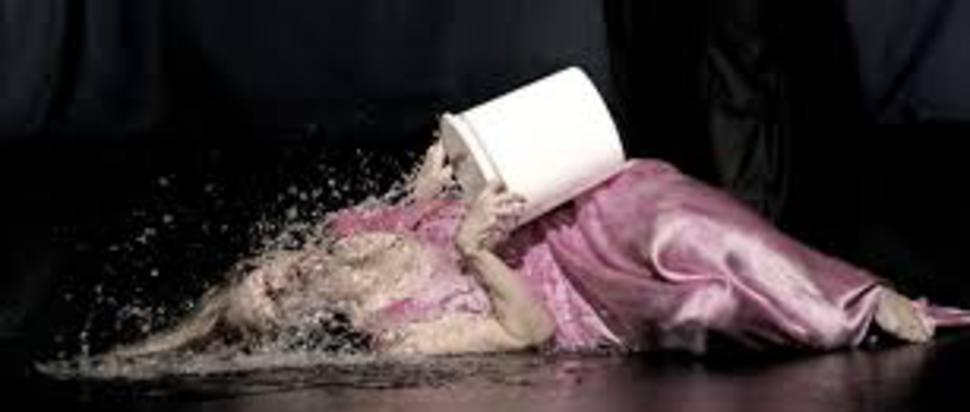
Later the atmospheric filmic projection of a forest, branches waving in the wind, spreads onto the floor of the stage.  A silent clip of couples at a party from the black and white 1938 film Der Blaufuchs (The Blue Fox) by Viktor Tourjansky and starring Zara Leander plays on the backdrop as a dancer gyrates to climax  on a man’s lap. Later the dancers move round the stage as if they too are at a cocktail party and even raise their glasses to the audience.  The boundaries of art and reality are further crossed as dancers address the audience directly. ‘Tell me your problem’ a dancer bends down to address the front row, ‘and I will scream for you.’ Julia Shanahan sloshes herself in real water from buckets – though it was a disappointment that more was not made of this. 
The overall experience conveys such a celebratory joyousness, this is the must-see performance of the festival.
Run ended

Thursday, 19 September 2013

Madame Freedom - Hyo Jim Kin and Hyung Su Kin

Madame Freedom @ King's Theatre

★★★★
Review by Stephanie Green | 19 Sep 2013
Published in The Skinny Magazine.


Tradition and modernity meet head-on in this stunningly beautiful interactive performance of dance, film and innovative computer-generated visuals by a husband and wife team: choreographer and dancer Hyo Jim Kin with artist Hyung Su Kin. The dance re-creates and is performed in front of extracts from the 1950's film Madame Freedom, about a woman who seeks self-expression through work and sexual experiences outside the constraints of marriage, a film which caused a shocking sensation at the time and even today is relevant, not only to Korea but to the west, posing the question: how free is free?
The performance starts with a film of a woman being dressed by servants in Hanbok traditional costume. Below this image, the dancer, dressed all in black - long-sleeved jacket, baggy trousers and black tight slippers -performs Tae Phyung Moo, Peace Dance, a traditional Korean dance similar to Tai Chi based on control of breath and stop/start moves, which then develops into contemporary modern dance, a spell-binding sequence as we see her breaking out of the straitjacket of the past.
Later we see her in a western-style slinky dress and high heels with her dance-teacher and lover, performing latino dances to music and song performed above in the film, referencing a craze for anything American which followed Korea's liberation from Japan. The focus shifts between dancer and film image - sometimes the two combine, when the dancer is superimposed in the film and appears to have climbed inside. Inevitably, pairing the dancers with the film means that the huge, bright image of the singer shimmying in a tasselled dress draws the audience's eye, and the silhouetted figures of the dancers in shadow below are dwarfed, but it appears this might be intentional. However, you can begin to see that the interplay of shadow and light is central to the play of duality, the central theme. In fact, the significance of the woman's first dance, the Tae Phung Moo, becomes clear.
Represented by the Tao symbol, the Korean Taegeuk, which celebrates the balance of opposites - light and shadow, tradition and modernity - this aesthetic infuses the whole performance. Everything is set up as a binary and built in pairs: the central screen is split, so that the image is warped each time; there are two screens, one either side of the stage, playing simultaneously. In one scene a film of the dancer leans in to an open gate-way, and we see her face. On the other side we see her in the identical position, but her back-view. This gateway, to Korean eyes, is significant since it is the gateway to the palace Kyong Bok's servants' quarters. In the same way, Madame Freedom wants to break out of the confinement of the life of a servant to her husband as house-wife.
Later when the dancer merges with the extraordinarily inventive black and white video designs swamping the screens and stage, the interplay of shadow and light, dancer and visuals is most successful, wonderfully expressive of her guilt and despair once her affair is over. This is intensely moving, especially when the white behind the black designs grow larger and brighter, forcing the black shapes to fall as the dancer flings herself to the floor, then rears in agony. While so much of the technology in this year's Edinburgh International Festival's theme of the interface between the arts and technology has hardly illuminated the art work it is paired with, Madame Freedom has been a striking exception.
Run nded
http://www.eif.co.uk/madamefreedom